Attic Ventilation in Knoxville: Why East Tennessee Roofs Fail From the Inside Out
Most roofs in Knox County do not wear out from the top down. They cook from underneath. When we pull a 14-year-old roof that should have lasted 22 and find brittle, curled shingles with rusted nail points showing through the decking, the cause is almost never the shingle. It is the attic below it.
Attic ventilation is the least visible part of a roof and the first thing a cheap bid drops. At Valor Roofing, we check intake and exhaust on every roof inspection we run, because a shingle warranty means very little if the attic underneath runs at 140 degrees in July.
What attic ventilation actually does
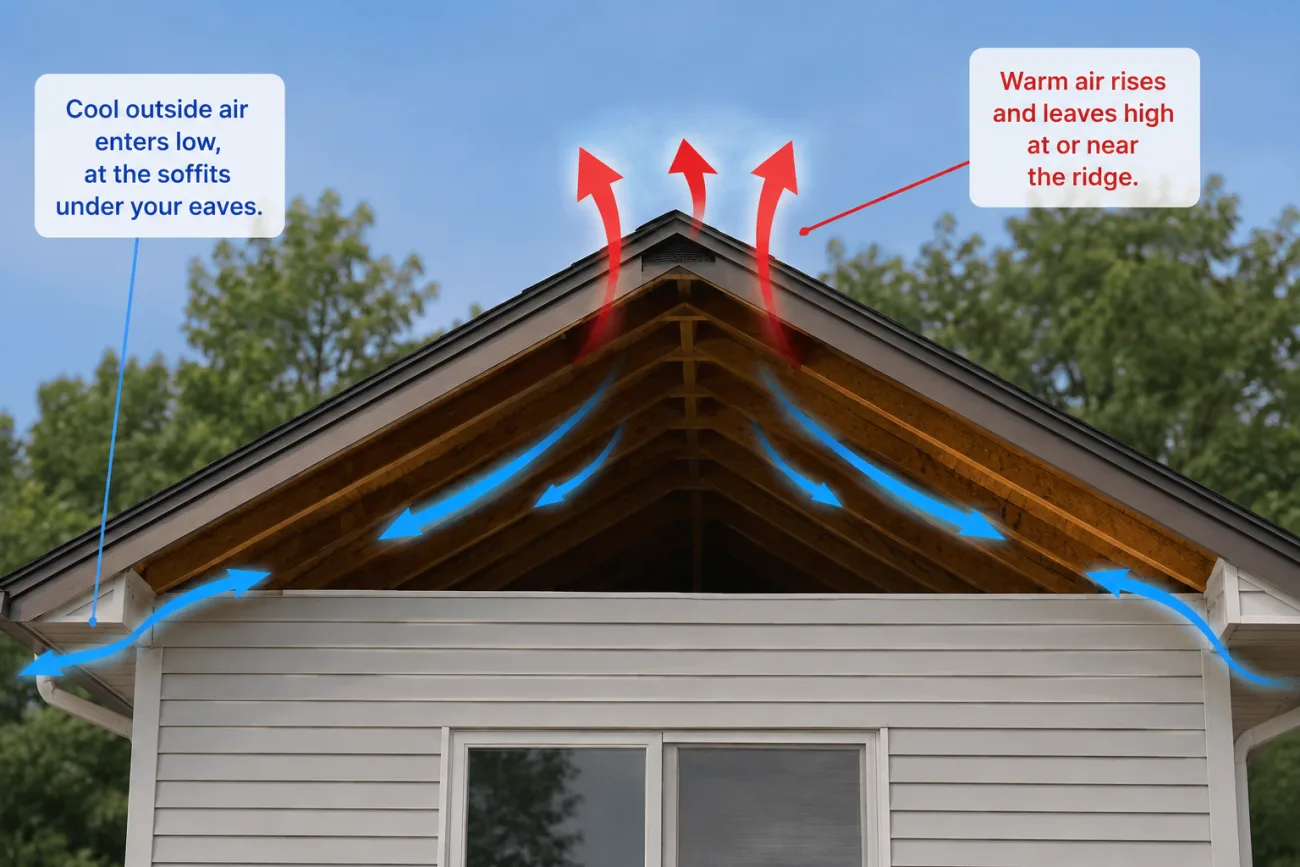
A vented attic works on a simple loop. Cool outside air enters low, at the soffits under your eaves, while warm air rises and leaves high at or near the ridge.
In summer, that flow flushes heat out before it can radiate down through your ceiling insulation or bake the underside of your shingles. In winter, it carries out water vapor from showers, cooking, and laundry. Trapped vapor condenses on cold sheathing, wets the insulation, and rots decking from the attic side down.
Both halves of the process matter. Exhaust with no intake is a stalled system, and it is the single most common defect we find on Knoxville roofs.
How much ventilation a Knoxville attic needs
The International Residential Code sets the baseline in Section R806.2: one square foot of net free ventilating area for every 150 square feet of attic floor. That ratio drops to 1/300 when the system is balanced, meaning 40 to 50 percent of the required area sits in the upper portion of the attic and the rest sits low. IIBEC's technical overview of R806 works through the arithmetic. Knoxville sits in Climate Zone 4A, so the vapor retarder condition attached to that exception applies to colder zones rather than to us. Here, the 1/300 allowance comes down to whether the system is actually balanced.
Net free area is not the size of the hole. It is the open area left after the screen, louver, and baffle block part of it. Every vent carton prints its rating, and most ridge vents fall between 12 and 20 square inches per lineal foot.
| Attic floor area | Required at 1/150 | Required at 1/300 (balanced) | Intake target | Exhaust target |
|---|---|---|---|---|
| 1,200 sq ft | 1,152 sq in | 576 sq in | 288 sq in | 288 sq in |
| 1,600 sq ft | 1,536 sq in | 768 sq in | 384 sq in | 384 sq in |
| 2,000 sq ft | 1,920 sq in | 960 sq in | 480 sq in | 480 sq in |
| 2,400 sq ft | 2,304 sq in | 1,152 sq in | 576 sq in | 576 sq in |
One rule overrides the math: intake should always meet or exceed exhaust. When exhaust wins, the ridge vent starts pulling conditioned air out of your house or pulling air backward through itself instead of drawing from the soffits.
Four ventilation failures we find in East Tennessee attics
Soffit intake buried by insulation
Usually a side effect of a well-intentioned energy upgrade. Blown cellulose or fiberglass gets pushed to the eaves, packs into the rafter bays, and seals off the soffit vents. The vents are still there. Air cannot get past them. Baffles at each bay fix it, and they belong in any insulation job on a ranch or split-level with shallow eaves.
Bath fans terminating in the attic
We find this on Knoxville homes of every age and price point. The fan runs, the flex duct ends two feet above the ceiling joists, and every shower dumps warm moisture straight into the attic. IRC Section M1501.1 is explicit that exhaust air cannot discharge into an attic, soffit, ridge vent, or crawl space. If your bathroom mirror clears quickly but the attic sheathing above that bathroom is stained dark, this is why.
A ridge vent with no slot cut
Ridge vent only works if the decking underneath it was cut open. On tear-offs of previous re-roofs we periodically find ridge vent nailed over solid sheathing, or a slot cut across the middle of the ridge and stopped short of both ends. From the ground it looks like a properly vented roof, but in truth it is just decoration and has no real ventilation property.
Mixed exhaust types on one attic
Ridge vent plus gable vents, or ridge vent plus a powered fan, creates a short circuit. The high vent draws from the nearest opening instead of the soffits, and the far end of the attic gets no flow. Pick one exhaust path and size it correctly.
How to tell your attic is under-ventilated without a ladder
You can check most of this from inside the house on a hot afternoon.
- Open the attic hatch in August. A working attic runs hot, but one that hits you with a wall of stale heat is not moving air. Oak Ridge National Laboratory has measured conventional attics near 127 degrees on a 92 degree day, with assemblies designed to shed that heat running roughly 20 degrees cooler.
- Compare upstairs to downstairs. A bonus room or second floor that sits 6 to 8 degrees warmer with the system running constantly points at the attic before it points at the HVAC.
- Look at your slopes from the street. Curling or a chalky look on one plane and not the others, well before the warranty term, is a heat signature.
- Check ceilings under the bathrooms. Faint brown rings or peeling paint with no plumbing leak above usually means moisture is condensing overhead.
- Stand under your eaves and look up. Solid vinyl or wood soffits with no perforations mean zero intake, regardless of what is at the ridge.
- Look for rust. Nail points showing through the decking with orange staining mean condensation has been forming for years.
What ventilation costs on a re-roof
Correcting ventilation during a replacement typically adds $300 to $800 to a Valor project, depending on how much soffit work the house needs and whether baffles have to be installed from inside the attic. That line is one of the first things a suspiciously low bid quietly removes.
A $500 ventilation correction on a roof that would otherwise fail eight years early is not an upsell, and any contractor should be able to show you the math on your specific attic.
Frequently asked questions
How do I know if my attic has enough ventilation?
Measure your attic floor area and divide by 150 to get the required net free ventilating area in square feet, then confirm that roughly half of it is intake at the soffits. If your soffits are solid or blocked by insulation, the attic is under-ventilated no matter how much ridge vent is installed.
Do ridge vents work in Knoxville?
Yes, provided the decking was slotted and there is matching soffit intake below. A ridge vent with no intake performs worse than no ridge vent, because it draws conditioned air out of the living space through ceiling penetrations.
Can poor attic ventilation void my shingle warranty?
It can. Most major manufacturers, including CertainTeed, condition their shingle warranties on ventilation that meets code minimums. Heat-related failures on an under-ventilated attic are a common basis for a denied claim.
Are powered attic fans a good idea in East Tennessee?
Usually not. A powered fan installed alongside a ridge vent short-circuits the airflow, and when intake is inadequate it pulls cooled air out of the house, raising cooling costs instead of lowering them. Fixing intake is almost always the better spend.
Does attic ventilation help in winter?
Yes. Winter airflow removes water vapor before it condenses on cold sheathing, which prevents mold, wet insulation, and rot. It also keeps deck temperature uniform, reducing ice damming during East Tennessee's occasional hard freezes.
The takeaway
Ventilation decides how long the rest of the roof lasts. Shingle grade, underlayment, and workmanship all matter, and none of them survive a decade of trapped heat and moisture. Before you spend money on premium materials, find out what the attic under them is doing.
Valor Roofing checks intake and exhaust on every inspection across Knoxville, Maryville, Oak Ridge, Farragut, and Seymour. During your consultation, we show you photographs of your own soffits and sheathing, so you get your actual roof rather than generic diagrams.
If your upstairs never cools or your shingles are aging faster than they should, request an inspection or call (865) 468-8726 and we will start in the attic.
Free, photo-documented inspection and a firm written price. No pressure, no in-home sales pitch.