Black Streaks on Knoxville Roofs: What Gloeocapsa Magma Is Actually Doing to Your Shingles
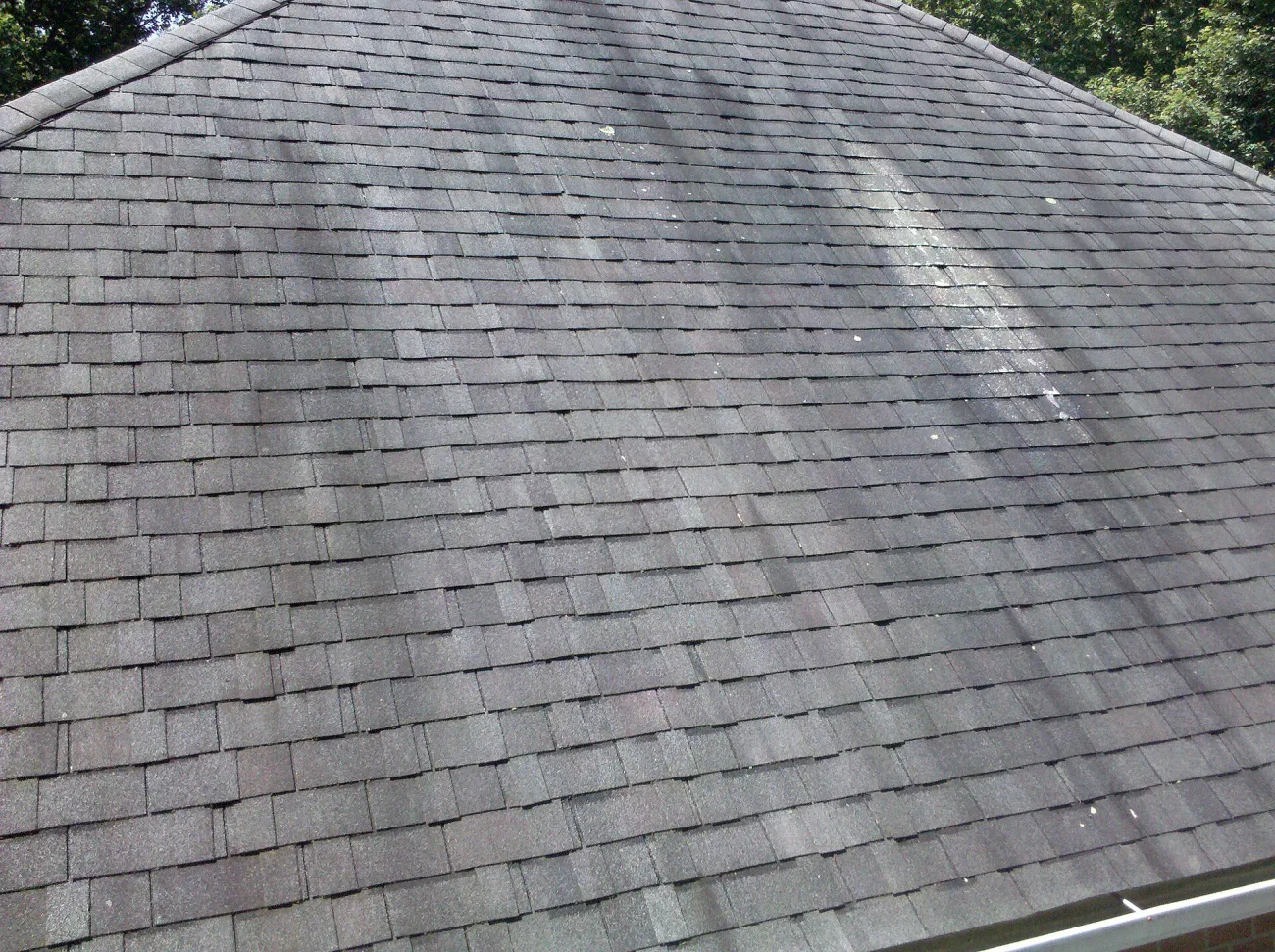
Drive through Bearden, Fountain City, or Sequoyah Hills in late summer and you will see the same thing street after street: dark vertical streaks running down the north-facing slope of otherwise healthy roofs. The house looks fifteen years older than it is, and the neighbor's roof looks even worse. Meanwhile, the one on the corner with no tree cover looks fine.
What is going on here? Homeowners usually assume the streaks are mold, dirt, or a roof falling apart. In reality, they are none of those. At Valor Roofing we get asked about this more than almost anything else, and the answer is algae.
What the black streaks actually are
Specifically, Gloeocapsa magma, a cyanobacterium that travels by air and settles on roof surfaces. According to the Asphalt Roofing Manufacturers Association, it is the most prevalent of several species that discolor roofs, and the pigments it produces gradually turn light-colored surfaces brown or black.
The organism protects itself from UV with a dark sheath, and that sheath is what you see. Growth starts as small spots and spreads into streaks running down the slope, following the path water takes as it drains. By the time the discoloration is visible from the street, the colony has usually been established for months.
Spores move rooftop to rooftop on wind and on animals, which is why the problem shows up across whole neighborhoods rather than on one isolated house.
Why Knoxville gets hit harder than most of Tennessee
The easy answer is that Knoxville's local conditions are perfect for this type of growth.
- Moisture: Knoxville averages close to 50 to 55 inches of precipitation a year, well above the national average, and July humidity stays high for weeks at a stretch. Algae needs surfaces that stay damp, and shingles here stay damp longer than they do in drier parts of the state.
- Tree canopy: The Tennessee Valley's mature hardwoods shade roofs, slow drying, and drop organic debris that holds moisture in valleys and along the eaves. Older neighborhoods with heavy canopy have the worst streaking in the county.
- Slope orientation: North and northeast slopes get the least direct sun and dry the slowest. On most Knoxville homes the streaking is dramatically worse on one plane, and that plane faces north almost every time.
Is algae damaging your roof?
Mostly, no. This is where our answer diverges from the pressure washing ads.
ARMA's own guidance states there is no scientific evidence that algae damages asphalt shingles, though it clearly affects appearance. A stained roof and a clean roof of the same age generally have the same remaining service life. The stains are ugly, but they are not comparable to a leak.
There are caveats, though. Dark staining lowers the roof's reflectance, which raises surface temperature and adds to the heat load your attic already carries in an East Tennessee August. Algae also rarely arrives alone, because the same shade and moisture that feed it also support moss and lichen, both of which are harmful.
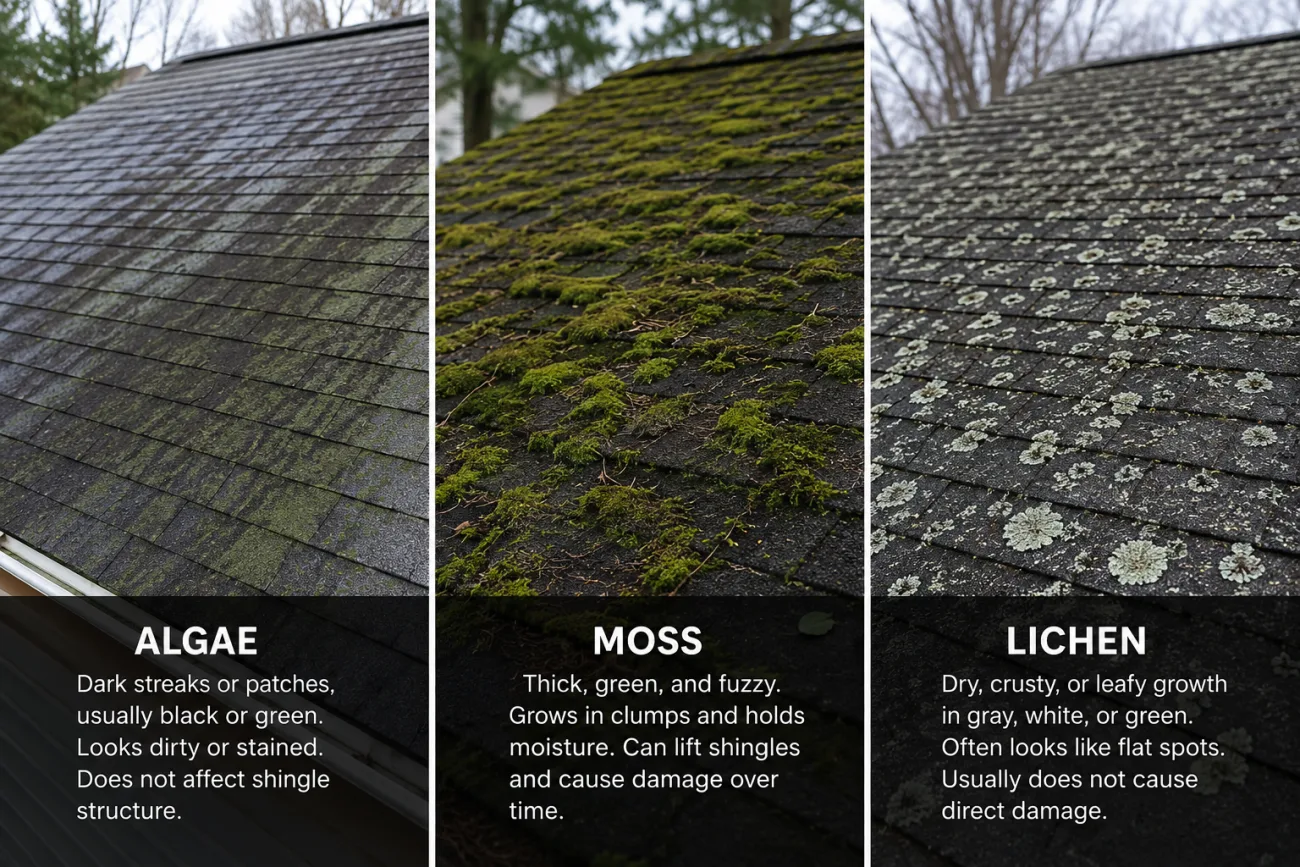
Algae, moss, and lichen are not the same problem
| Algae (Gloeocapsa magma) | Moss | Lichen | |
|---|---|---|---|
| Appearance | Flat black or brown streaks running down-slope | Green, spongy clumps with visible height | Crusty gray-green patches, often circular |
| Where it starts | Whole slope, worst on north exposure | Valleys, shaded eaves, under overhanging limbs | Shaded slopes, older roofs |
| Damage to shingles | Cosmetic in the short term | Lifts shingle edges and holds water against the roof | Rhizines penetrate the granule layer; removal takes granules with it |
| Urgency | Low | Medium | Medium to high |
| Right response | Leave it, soft wash, or plan for AR shingles | Remove and correct the shade or debris source | Professional assessment before any cleaning |
If you cannot tell which one you have from the ground, that is exactly what a roof inspection is for. We photograph it and show you.
Your four options, ranked honestly
- Do nothing: For a roof past year fifteen, this is often the right call. Cleaning a roof that will be replaced in four years is money spent on appearance alone.
- Soft wash, never pressure wash: ARMA specifically advises against high-pressure systems on asphalt shingles, and its published method uses a diluted sodium hypochlorite solution applied gently and rinsed. High pressure strips granules, which is real damage in exchange for a cosmetic fix. Confirm the cleaner follows the manufacturer's protocol, because the wrong chemistry can void a shingle warranty.
- Install zinc or copper strips at the ridge: Rainwater carries trace metal ions down the slope and suppresses regrowth. It works best as prevention on a clean roof and does little for staining already in place.
- Replace with algae-resistant shingles: AR shingles carry copper-bearing granules that release slowly over years. CertainTeed's StreakFighter system carries a 10-year algae-resistance warranty on Landmark and 15 years on Landmark Pro. Valor is a CertainTeed ShingleMaster, and we spec AR shingles by default on shaded Knoxville roofs because the upcharge is small relative to how visible the problem is here.
The part nobody mentions: matching
Asphalt shingles fade under UV, and in this market they also darken unevenly with algae. Ten years in, the shingles on your roof are no longer the color you bought. So when a tree limb comes crashing down on the back slope and you find yourself needing a 40-square-foot repair, the new bundles will not match and look like a patchy job from street level. For people who truly care about the appearance of their home, this will typically warrant a full replacement.
Discontinued color lines make it worse. Manufacturers retire blends regularly, and a roof installed in 2014 may have no current equivalent at all.
That mismatch is the hinge point in most repair-versus-replace decisions in Knox County, and it is worth understanding before you make one.
Frequently asked questions
What causes black streaks on a roof?
Black streaks are algae, most commonly Gloeocapsa magma. It settles from the air onto shingles, grows where surfaces stay damp, and produces a dark protective pigment that shows up as vertical streaking down the slope.
Do black streaks mean I need a new roof?
No. Algae staining is a cosmetic condition and does not by itself indicate a failing roof. Curling shingles, exposed mat, granule loss in the gutters, or an active leak are the signs that matter, and an inspection will separate the two.
Can I pressure wash algae off my shingles?
You should not. ARMA advises against high-pressure washing on asphalt roofs because it removes protective granules and shortens roof life. A low-pressure soft wash using a manufacturer-approved solution is the accepted method.
Why is only one side of my roof streaked?
North and northeast slopes receive the least sunlight and stay damp longest, so algae establishes there first. Shade from mature trees produces the same effect on any slope.
Do algae-resistant shingles actually work?
They do, for a defined period. Copper-bearing granules leach slowly and suppress growth, and manufacturers back the performance with a specific warranty term, commonly 10 to 15 years depending on the product line. They slow the problem rather than eliminating it permanently.
Where to go from here
Black streaks are the most visible roofing symptom in Knoxville and one of the least urgent. The useful question is not how to make them disappear this month. It is what the roof underneath the staining has left in it, and whether you are close enough to replacement that cleaning is money you will not get back.
Valor Roofing inspects roofs across Knoxville and the surrounding towns and will tell you plainly which of the four options fits your roof's age, including the option where you spend nothing. Request an inspection or call (865) 468-8726.
Free, photo-documented inspection and a firm written price. No pressure, no in-home sales pitch.