The Knoxville Roofing Glossary: Decoding the Terms on Your Estimate
Roofing estimates are written by roofers for roofers. Most homeowners get one, recognize about half the words, and end up comparing bids on the only line they fully understand, which is the total. That is how a bid missing $1,400 of necessary work wins the job.
This glossary defines the terms that actually appear on Knox County roofing quotes, in plain English, with a note on why each one shows up and what it means when it is missing. Valor Roofing put it together from the questions homeowners ask us during estimates. Bookmark it and read your quote alongside it.
Measuring and pricing
Square
The standard unit of roofing area. One square equals 100 square feet of roof surface. A typical Knoxville ranch runs 18 to 25 squares. Roof surface is always larger than the home's footprint, because a pitched roof covers more area than the ground beneath it.
Pitch
The slope of the roof, written as rise over run. A 6/12 pitch rises 6 inches for every 12 horizontal inches. Anything at 8/12 or steeper generally requires additional safety equipment and slower production, so it carries a labor premium. If two bids differ sharply and one never mentions pitch, ask how each was measured.
Waste factor
The percentage added to material orders to cover cuts at valleys, hips, and rakes. Simple gable roofs run around 10 percent. Cut-up roofs with multiple dormers can exceed 15 percent. It is a legitimate line, not padding.
Tear-off
Removal and disposal of the existing roof down to the decking. Includes dumpster, labor, and magnetic nail sweep. A quote without a tear-off line is either a layover or an incomplete quote.
Layover
Installing new shingles over the existing layer rather than removing it. The City of Knoxville does not require a building permit for roofing where the first layer of shingles stays intact and a second layer is installed over it, which is one reason layovers persist here. That exemption is not an endorsement. A layover hides rotten decking, traps heat, shortens the new roof's life, and cannot be inspected. Valor does not install them.
Roof anatomy
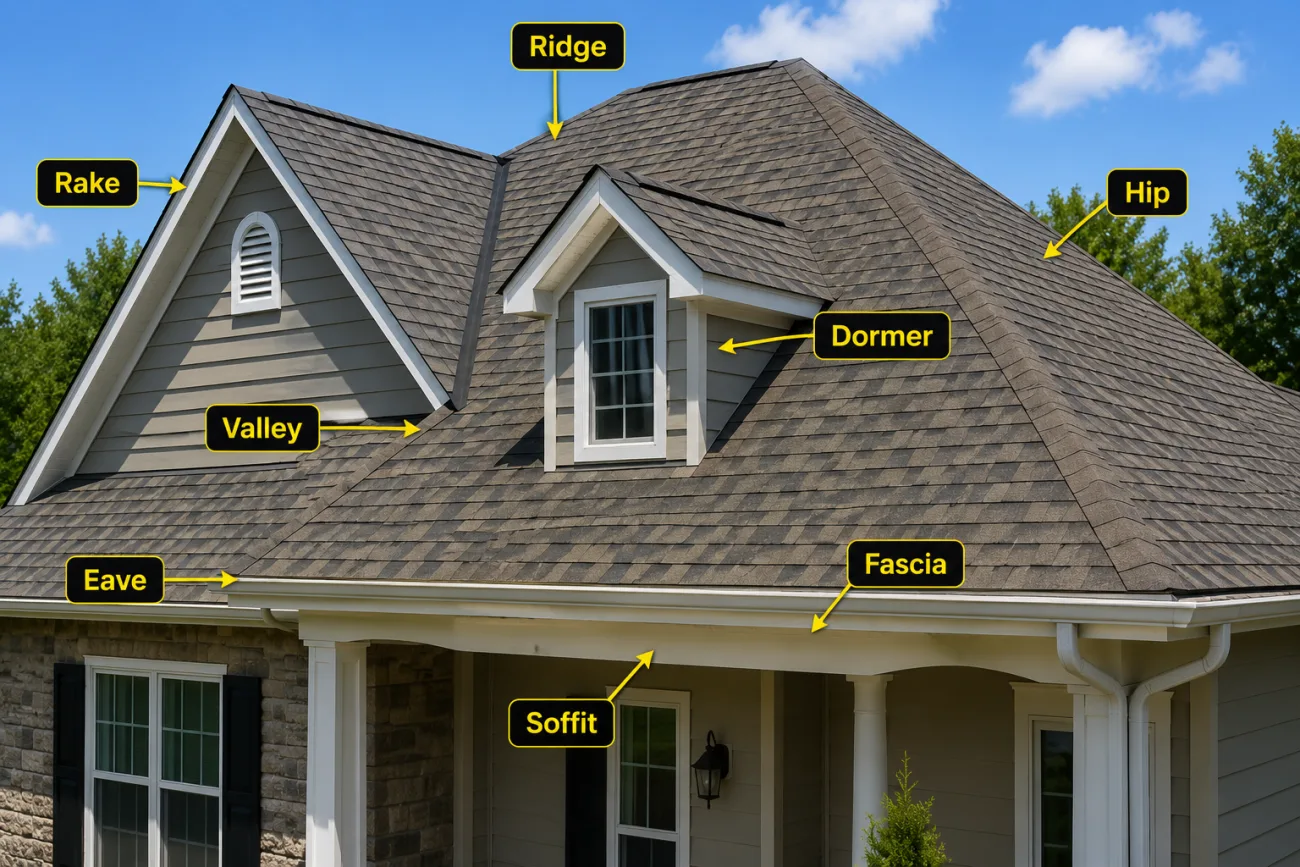
You will see these words used positionally throughout an estimate.
- Eave. The lower edge of a slope, where the gutters hang.
- Rake. The sloped edge of a gable end.
- Ridge. The horizontal peak where two slopes meet.
- Hip. The external angle where two slopes meet on a diagonal.
- Valley. The internal angle where two slopes meet, carrying concentrated water flow.
- Fascia. The vertical board at the eave that the gutter attaches to.
- Soffit. The underside of the eave overhang, where intake ventilation lives.
- Dormer. A framed projection with its own small roof, and a frequent leak location.
Structure and layers
Decking
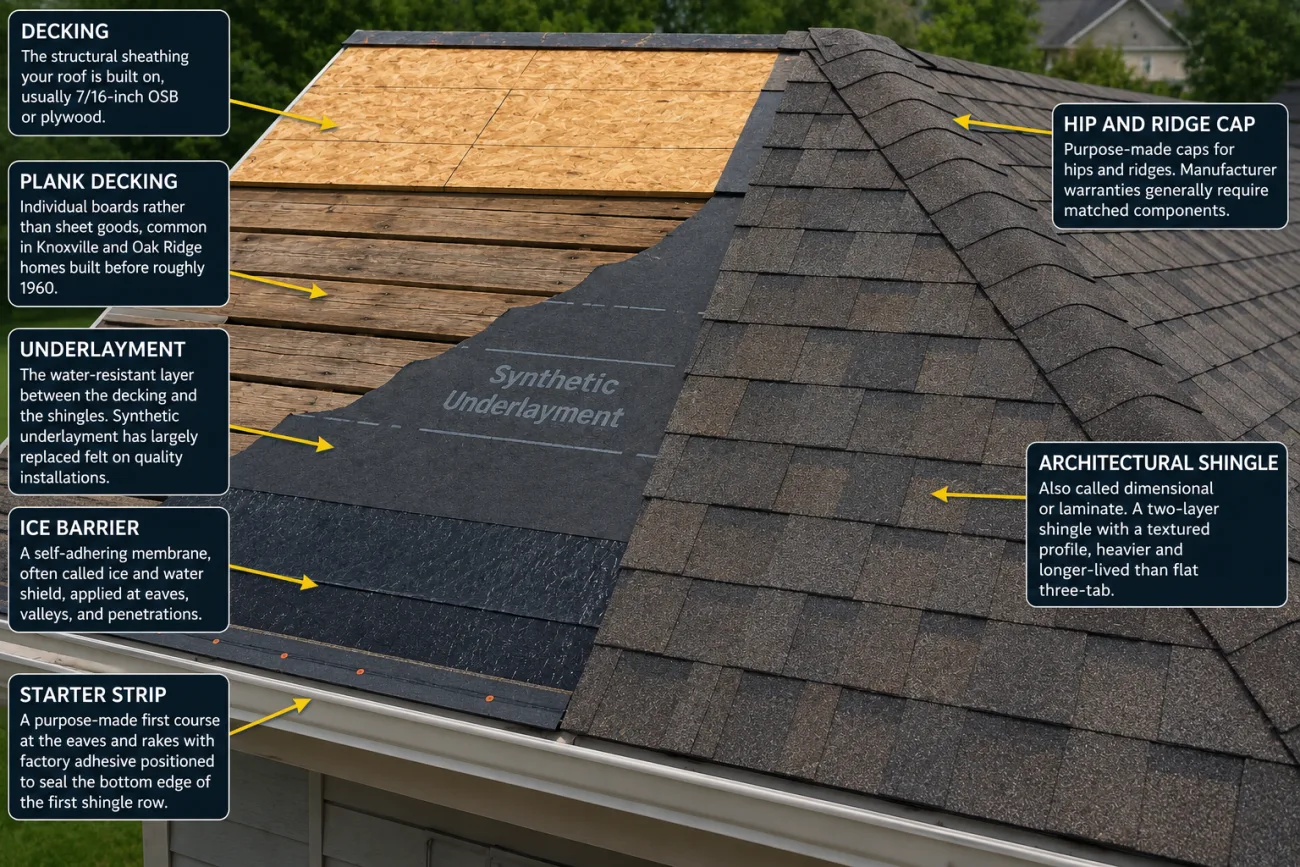
The structural sheathing your roof is built on, usually 7/16-inch OSB or plywood. Nothing above it performs if the decking is soft. Replacement is priced per sheet and typically appears as a contingency, since the condition is unknown until tear-off.
Plank decking
Individual boards rather than sheet goods, common in Knoxville and Oak Ridge homes built before roughly 1960. Gaps between planks affect fastener holding and sometimes require overlay sheathing before shingles can be installed to manufacturer specification. It is a real cost difference, and it is one worth asking about if your home is older.
Underlayment
The water-resistant layer between the decking and the shingles. Synthetic underlayment has largely replaced felt on quality installations. It is the roof's second line of defense when wind drives rain under a shingle.
Ice barrier
A self-adhering membrane, often called ice and water shield, applied at eaves, valleys, and penetrations. The IRC requires it where the jurisdiction has determined a history of ice forming along eaves. East Tennessee sits at the margin, and some contractors omit it entirely on the theory that we do not get ice. We install it at valleys and penetrations regardless, because it is also the best defense against wind-driven rain.
Starter strip
A purpose-made first course at the eaves and rakes with factory adhesive positioned to seal the bottom edge of the first shingle row. Cutting up regular shingles as starter is a shortcut that puts the sealant in the wrong place and is a common cause of edge blow-off.
Architectural shingle
Also called dimensional or laminate. A two-layer shingle with a textured profile, heavier and longer-lived than flat three-tab. This is the residential standard in Knox County.
Hip and ridge cap
Purpose-made caps for hips and ridges. Manufacturer warranties generally require matched components, so a system built from cut three-tab shingles may not qualify for full coverage.
Edges, flashing, and ventilation
Drip edge
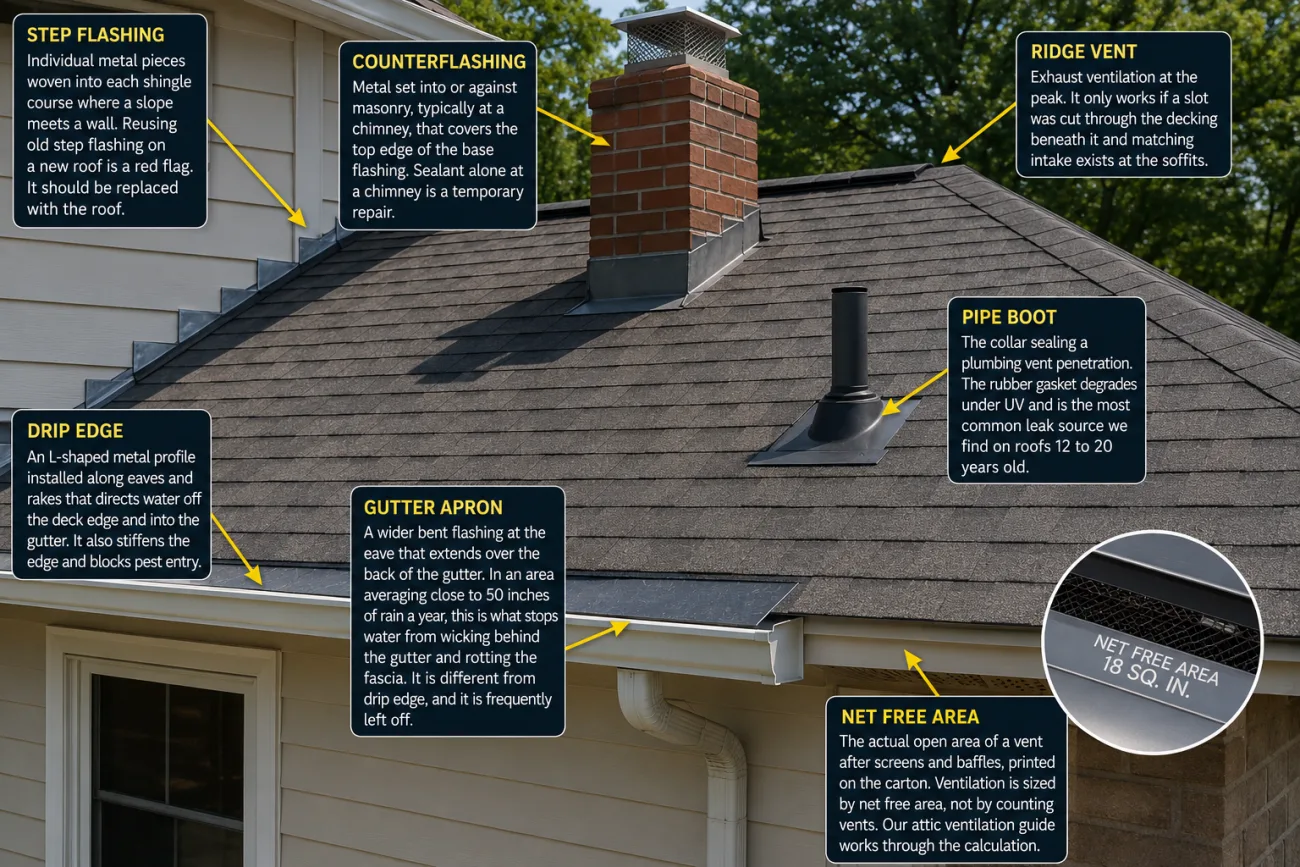
An L-shaped metal profile installed along eaves and rakes that directs water off the deck edge and into the gutter. It also stiffens the edge and blocks pest entry.
Gutter apron
A wider bent flashing at the eave that extends over the back of the gutter. In an area averaging close to 50 inches of rain a year, this is what stops water from wicking behind the gutter and rotting the fascia. It is different from drip edge, and it is frequently left off.
Step flashing
Individual metal pieces woven into each shingle course where a slope meets a wall. Reusing old step flashing on a new roof is a red flag. It should be replaced with the roof.
Counterflashing
Metal set into or against masonry, typically at a chimney, that covers the top edge of the base flashing. Sealant alone at a chimney is a temporary repair.
Pipe boot
The collar sealing a plumbing vent penetration. The rubber gasket degrades under UV and is the most common leak source we find on roofs 12 to 20 years old.
Ridge vent
Exhaust ventilation at the peak. It only works if a slot was cut through the decking beneath it and matching intake exists at the soffits.
Net free area
The actual open area of a vent after screens and baffles, printed on the carton. Ventilation is sized by net free area, not by counting vents.
Insurance and warranty terms
ACV and RCV
Actual cash value is replacement cost minus depreciation, and it is what many carriers pay first. Replacement cost value is the full cost to replace. Which one your policy carries determines your out-of-pocket exposure.
Recoverable depreciation
The withheld portion of an RCV claim, released after the work is completed and documented. It is money you are owed, and it is forfeited if the job is never finished or never invoiced properly.
Workmanship warranty
Coverage on the installation itself, issued by the contractor rather than the manufacturer. Manufacturer warranties cover material defects only. Valor's workmanship coverage runs 25 years and transfers with the home.
What the missing lines cost you
| Line item | What it does | What happens when a bid omits it |
|---|---|---|
| Ventilation correction | Balances intake and exhaust | Heat-shortened shingle life, possible warranty denial |
| Gutter apron | Keeps water out from behind the gutter | Fascia rot within a few seasons |
| New step flashing | Seals roof-to-wall transitions | Wall leaks that mimic siding failure |
| Starter strip | Seals the first course at eaves and rakes | Edge blow-off in the first strong wind event |
| Decking contingency | Prices unknown rot in advance | Change orders mid-project at whatever rate is quoted then |
| Pipe boots | Seals plumbing penetrations | The most common leak on a roof under warranty |
Frequently asked questions
What is a square in roofing?
A square is 100 square feet of roof surface. Contractors price materials and labor by the square, so a 22-square roof means roughly 2,200 square feet of actual roof area, not floor area.
What is the difference between drip edge and gutter apron?
Drip edge is an L-shaped metal at the roof edge that directs water away from the fascia. Gutter apron is a longer bent profile that extends over the back edge of the gutter, which is the better detail in high-rainfall areas like East Tennessee.
Do I need a permit to replace a roof in Knoxville?
Full replacements generally require a permit from the appropriate authority, and City of Knoxville addresses and unincorporated Knox County addresses go to different offices. The city does list roofing as exempt where the existing layer stays intact and a second layer is installed over it.
What does underlayment do?
Underlayment is the water-resistant layer between decking and shingles. It protects the roof deck during installation and provides secondary protection when wind drives rain past the shingle surface.
What is recoverable depreciation on a roof claim?
It is the amount your insurer withholds from an initial replacement cost payment and releases once the work is completed and documented. You recover it by finishing the job and submitting proof, so it is worth tracking through the claim.
Using this list
An estimate you can read is an estimate you can compare. If a quote is missing a term from this page that another quote includes, that is not a detail, it is a scope difference, and it usually explains the price gap.
Valor Roofing writes estimates in language homeowners can check, and we are happy to walk through a competitor's quote line by line without asking you to sign anything. Request an estimate or call (865) 468-8726 with a quote you would like explained.
Free, photo-documented inspection and a firm written price. No pressure, no in-home sales pitch.